Showing posts with label medicinal herbals. Show all posts

Wednesday, April 4, 2012

Alternative Healing Wednesdays


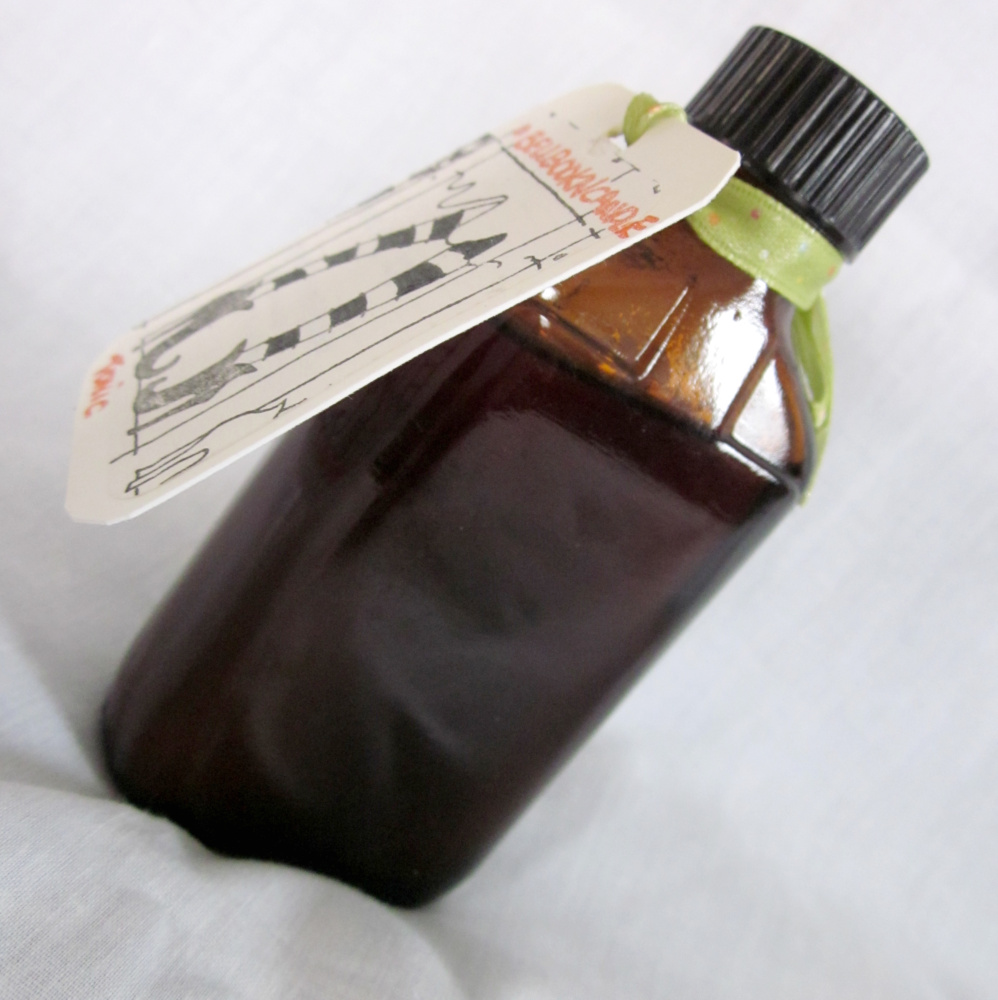
Herbal Elixer in a Bottle


TINCTURES

The purpose of making a tincture is to extract the part of the herb that will assist in healing. You use a solution to accommodate this process.  These “solutions” are alcohol, vegetable glycerin, or vinegar. Getting “constituents” (mentioned in last Wednesday’s blog) out of the herb is the purpose of using these solutions.

To prepare:

With dried herb, a ratio of 1 part herb, to 5 parts alcohol (Vodka) / or 2 parts fresh herb to 5 parts alcohol.

Begin by chopping or grinding the herb 

Sterilize a pint jar and its lid

Then add the herb, and pour in the alcohol over the herb 

Leave in a warm, dark place for 2 weeks, shaking the herbs two to three times a day. 

After two weeks, strain with a coffee filter (I have a funnel I place mine into) into a bottle or jar (be sure to sterilize the jar first). If any herb is left in the solution, it will possibly spoil the solution. Store with the cap secured tightly in a cool place. Label and date your bottle. 

If stored correctly, and sterilization used, they should keep indefinitely.

FLUID EXTRACT

Special equipment is used for this process. To prepare it, the herb is soaked in alcohol for two weeks. Then, the strained fluids are evaporated under high pressure.  A residue is left after this process, which is diluted to the correct strength.

Generally these are 2X stronger than a tincture and will have only a minute amount of alcohol. The amount recommended is usually very small, usually drops.

Monday, March 26, 2012

Herbal Mondays


The Echinacea plant is native to the areas west of Ohio, in America.  It belongs to the Aster (Asteraceae) family.  Echinacea can grow as high as 2-3 feet.  The leaves are “thick, rough, hairy, and broadly landscaped, 3-8 in. long (Hutchans, 113)…” The flowered head appears from July to October. The color of the flower ranges from white to a pale purple.

The Lakota used the Echinacea plant (freshly scraped root) for hydrophobia, and snakebites.  The Cheyenne used boiled leaves and stems making a yellow colored liquid to draw poison out of a snake bite and to relieve the itch of poison ivy.(James Stubbendieck, et al)
                                                                        
For Homeopathic use, the whole fresh Echinacea plant is tinctured.  It is recommended for Appendicitis, bites of rabid animals, blood poisoning, just to name a few.  Echinacea’s dried root homeopathic is used at a ratio of 1:2 which means 75% of the tinctured root to 25% water.  For the fresh root, it is used at a ratio of 1:5, meaning 50% tincture and 50% water[i]. 


I was taught that the volatile properties of the tinctures were reduced by continuous dilutions and succession (vigorous shaking). The author of the above information stated you should feel a “buzzing” on the tongue. 
With proper homeopathic dilution, you would take the tincture and dilute it with 99 parts of water and alcohol before each succession for 1C homeopathic solution or one part tincture to 10 parts water or alcohol for a 1X solution.  

Typically you would see the remedies labeled 6C, 30C, 200C, 1M (1,000C) or higher.  For home use 6C and 30C are what is usually recommended. 

As with Flower Remedies, Homeopathic Remedies use the “essence” of a plant, mineral, etc. That “essence”  is as Robin Hayfield states, “entering the realms of pure energy (15)”.  It is actually the signature of the plant, or other organism.  It acts upon the vital force of the body. 

References:
Hayfield, Robin.  The Family Homeopath: safe, natural, effective health care for you and your children.
     Healing Arts Press, 1994
Hutchens, Alma R.  Indian Herbalogy of North America.  Shambhala, 1991
James Stubbendieck, Stephen L. Hatch, and Charles H Butterfield.  North American Range Plants, 4th Ed.
     University of Nebraska Press, 1992.
Weyers, Elisheva. http://elisheva-weyers.suite101.com/echinacea-a-natural-immune-stimulant-a236105


[i] Use only spring water or distilled water. 

Tuesday, March 13, 2012

Alternative Healing


Today I am going to discuss Herbal Healing, in general.  Herbal Healing deals with the therapeutic nature and properties of herbal plants. Herbs can be medicinal, culinary or both. An example of a medical herb is Echinacea. For an example of culinary herbs we may use something like Marjoram. For both culinary and medicinal we could use ginger root, as an example.

The active portion of the herb is called a “constituent[i]”.  This is the portion that scientists had isolated and synthesized to prepare medicine.  Unfortunately, this is not the whole aspect of healing with herbs! The whole plant or the active portion is necessary in order to get the full benefit of the herb, which is a living organism. The isolation of one part is not a natural harmonious act, and does not contain the effects of environment on the plant.  This is the reason that synthesized herbal parts have caused poisonous or even sometimes dangerous side-affects.

 Melissa or Lemon Balm, from my garden

Herbs can be gathered in the wild (wild-crafting), purchased from a store (usually in a dried form), or grown in the garden[ii]. Growing your own herbs can be a enriching experience.  You can plant the seed and watch its growth from seedling to mature plant.  If you purchase from a store, make sure you know where their herbals are harvested, and how they are grown. Do not wild-craft unless you are completely positive about the identification of the herbal plant.  Some herbals look very much like other plants that are poisonous! 

My suggestion is to begin by finding a good herbal supply store. While beginning to work with herbs, you can decide on a few herbs to plant in your garden or in pots (if you have no yard) and start growing herbs.

"Constituents" will be next week.


[i] To be discussed in the next blog
[ii] Suggested book list will be in an upcoming blog